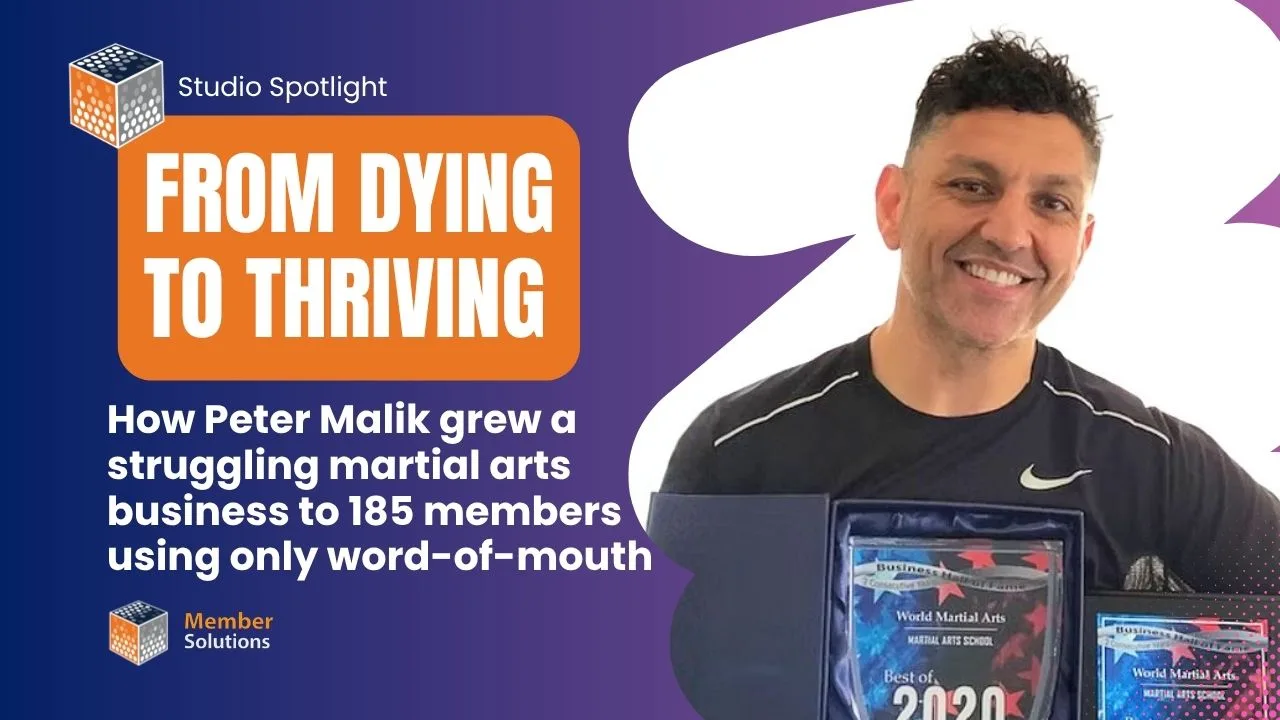
When Peter Malik bought a struggling martial arts school in Palo Alto in 2007, it had 30 students and was barely staying afloat. Today it has 185, and it’s still growing, and he’s never run a single ad to get there. No Facebook campaigns, no Google spend, no boosted posts. His only digital presence is a Yelp page. Every student he has came from someone who was already a member telling someone else.
That kind of growth doesn’t happen by accident, and it doesn’t happen because of a clever marketing strategy. It happens when every family that walks through your door feels like they belong there, when you’re honest about your prices and your policies from the very beginning, and when the thing you’re building is genuinely worth talking about.
Looking for the exact words to use when raising rates, handling a cancellation request, or explaining your policies? Download our free Freeze & Cancellation Templates — plain-language scripts for freeze requests, cancellation conversations, and win-back follow-ups.

“How do martial arts schools grow to 185 students without advertising?”
Peter Malik of World Martial Arts in Palo Alto, California grew from 30 to 185 students between 2007 and 2026 using a community-first model and no paid advertising. His growth is driven by parent-to-parent referrals, which are triggered when parents see a real, visible change in their child. Retention is built on three main practices: a family program where parents train alongside their kids rather than sitting in chairs watching, a pricing model that starts below competitors and increases incrementally in small amounts tied to belt progression, and a transparent hold and cancellation policy that he reviews with every family at sign-up so there are no surprises later. His stated philosophy is: “I’m not a business. We are a community.” He uses Member Solutions for monthly billing visibility and hold and freeze management.
The School Nobody Expected
Peter didn’t set out to own a martial arts school. He kind of stumbled into martial arts altogether. In 1992, his best friend was brought to an introductory lesson and asked if he wanted to bring someone along. Peter said yes, mostly just to be a good friend. He admits he was skeptical going in. “And I was hooked instantly,” he says.
He started training, started teaching in 1996, spent years instructing at various schools around the area, and eventually found his way to Strikeforce (the MMA promotion run by Scott Coker), where he worked on the business side of combat sports and got a different kind of education. When UFC purchased Strikeforce, he made a decision that probably didn’t surprise anyone who knew him well: he left and went back to teaching. The business of fighting wasn’t what he was after. The floor was.
He found a school in Palo Alto that was struggling, with a student body of about 30 people and not a lot of momentum. He decided to purchase it, stepped in, and started building something different from the ground up. That was 2007. Seventeen years later, the school has 185 students and is still growing, all without a dollar spent on advertising.
”I’m Not a Business. We Are a Community.”
When you ask Peter what makes World Martial Arts different from other schools in the area, he doesn’t talk about curriculum or belt systems or how his approach to applicable martial arts sets him apart from more traditional dojos, though it does, and he does talk about that too. The first thing out of his mouth is this: “My number one thing is I’m not a business. We are a community.”
That’s not a tagline he put on his website. It’s a philosophy that shapes how every single decision gets made, from how he structures his pricing to how he handles it when a family says they want to leave. He doesn’t upsell. He doesn’t push people to buy gear or add-ons they don’t need. Palo Alto has a pretty wide economic range. He’s got parents who own commercial buildings and hold technology patents training alongside parents who are working two jobs, and he treats every family the same way. “When I have a student and a family that trains with us, it has to feel like home,” he says.
And it genuinely does. Students come straight from school, do their homework at the studio, train, and go back to their homework. That level of comfort doesn’t just happen. It’s built intentionally, over years, through the way Peter and his team show up every single day. World Martial Arts holds movie nights, picnics at the park, beach days at Santa Cruz, pool days in summer. What’s striking is that parents whose kids have long since graduated and moved on still show up to these events, not because they’re getting anything out of it, but because the community Peter built kept them in even after their reason for joining technically ended. “Even though they’re not training anymore, they’re still part of the family,” he says, and the way he says it, you can tell that’s exactly what he was going for.
How Word of Mouth Actually Works
A lot of gym and studio owners say they grow through word of mouth, but when you push on it, what they really mean is they don’t have a budget for paid ads and hope people will tell their friends. For Peter, word of mouth is an outcome that he understands clearly enough to describe the mechanism behind it.
“When a parent sees a change in their child for the better,” he says, “they are going to recommend other parents, their friends to go.” That’s the whole thing. A parent watches their kid come home more focused, more confident, less likely to panic in a stressful situation, and they can’t help themselves. They tell someone. And because they’re already in a community of parents who talk to each other at pickup, at soccer games, at the school gates, the recommendation lands with real weight.
It shows up plainly in the Yelp reviews. Parent after parent writes some version of the same story: they were shopping other schools, a friend said try this place, they did, and they didn’t look back. Peter didn’t manufacture that. He created the conditions for it by producing results that parents can see, and the referrals followed naturally. There’s no shortcut to that, and there’s no advertising campaign that replaces it. But when it’s working, it works better than anything else.
The Family Program — Why He’s Probably the Only One Doing This in the Bay Area
One of the most distinctive things about World Martial Arts is that Peter doesn’t run a kids program. He runs a family program, and the difference is more significant than it might sound.
In most martial arts schools, a kids class is designed for kids, which means parents sit in chairs along the wall, scroll their phones for an hour, and wait. Peter looked at that model and saw a missed opportunity. Not just a business opportunity, but a real-life one. He designed a program where parents are on the mat training alongside their children, and he believes he’s the only school in the Bay Area doing it this way.
The younger kids — ages six through eight — start in the Little Dragon program, which is specifically designed to get them ready to train with adults. The whole focus at that level is teaching them to focus and enjoy the process of getting stronger, and Peter does this partly through a trick that sounds simple but is surprisingly effective: at his school, push-ups are prizes. When a kid does something well, they earn push-ups or pull-ups. “I’m changing their mentality to enjoy getting stronger,” he explains. When kids are competing to earn push-ups instead of dreading them, the whole energy of the room shifts. Once they’re genuinely ready, once they can focus, stay present, and actually drill with a partner, they graduate into the family program and work side by side with the adults in the room.
“You have an 8-year-old focused and then you have a 40-year-old, their dad, simultaneously working out — and it’s fantastic,” he says. And it works because Peter teaches applicable martial arts rather than traditional forms. There’s no abstract choreography that makes sense to an adult practitioner but loses a child’s attention in thirty seconds. Everyone is hitting pads, drilling with partners, doing something real together. The activity is shared, which means the experience is shared.
The longer-term benefit of this design is something Peter talks about explicitly with parents. “Before that child becomes a teenager,” he tells them, “you need to find something that you guys connect with — because that’s going to create the bonds when they start to become that teenager.” If the parent and child have already built a shared thing, a place they go together, a skill they’re developing together, a community they both belong to, those bonds are already established before the harder years arrive. The fact that this also keeps families enrolled longer and makes cancellations significantly less likely isn’t an accident. It’s the right thing to do, and it happens to be good business at the same time.
Pricing: Start Low, Raise Small, Be Honest
World Martial Arts has won Best of Mountain View seven years in a row, which is the kind of recognition that might make an owner feel justified in charging a premium. Peter still prices himself below every other school in the area, deliberately. “The reason why is I do want to be affordable,” he says simply.
His approach to setting rates is methodical: he calls the other schools in the area, finds out what they’re charging, and undercuts by a bit. Then he starts students at a flat monthly rate with unlimited classes, no restrictions on how often they can come, no tiered class packs to navigate. Most beginners come two or three times a week at first, but as they get more invested in their training and more embedded in the community, they come more. Some end up there seven days a week, and they’re still paying the same flat rate they started at.
When students advance to the intermediate level and unlock classes on Fridays and Saturdays, the rate goes up, but only by a modest amount, and the way Peter frames it matters as much as the number. “When I raise the rate, I never raise the rate by $20,” he says. “I raise it by $5 a week is what I tell them. It’s much more manageable. $5 is a cup of coffee.” That framing works because, by the time the increase happens, the relationship is already there. A parent who has watched their child earn a new belt, get more confident in a sparring situation, and start showing up five days a week instead of two is not going to say no to $5 a week, especially when the owner levels with them about it plainly and without any pressure. “If the parent is seeing the value that you’re giving their child and their family and you say, ‘We did have a small rate increase, $5 a week’ — they’re not going to say no,” he says. The trust was built first. The rate increase follows from that trust, and at that size, it barely registers.
Want to see how Member Solutions helps you manage billing tiers and communicate rate changes? Join our upcoming webinar where the Product Team walks through pricing setup, hold management, and billing automation. Register for the webinar →
The Hold Policy: Summer Is Predictable, So Plan for It
Palo Alto’s summers have a particular rhythm that Peter knows well: families travel, kids go off to camps and programs, and attendance dips. It happens every year, and rather than fight it or get caught off guard by it, he builds it into his annual plan from the start.
“All martial arts schools tend to do it — it’ll die a little in summer, it’ll pick up when school starts again,” he says. “It’s just planning ahead and knowing your cycles. If you look at your stats, you’re going to see which months go up and which months go down — and you just have to plan ahead.” His hold policy makes it easy for families to take a pause without fully walking away: $75 to freeze a membership, with the difference between the hold fee and the normal monthly rate refunded. It’s straightforward, it’s fair, and because he explains it at sign-up, members already know about it before they ever need it.
When revenue dips in the slow months, he doesn’t just wait it out. He fills the gap with events and specials that keep the school active and bring families through the door. Summer camps are one option. Brick-breaking seminars, where community members pay $20 for a shot at breaking bricks, are another. These events won’t replace a full month of tuition, but they keep the energy and the connection alive during a season when other schools go quiet, and they’re the kind of thing that members talk about afterward.
The Cancellation Policy: Have a Real Conversation First
Peter goes through his hold and cancellation policy with every single family at sign-up, every time. “I don’t hide anything,” he says. By the time a family has a reason to cancel, they already know what the process looks like, and the process, at its core, is just a conversation.
“If you want to cancel, set up a meeting. Let’s talk.”
That might sound simple, but it’s doing a lot of work. Peter tells the story of a student who was doing really well, then suddenly started pushing back against class, fighting with his parents about going, wanting out. His parents brought it to Peter assuming it was a straightforward cancellation. Peter sat down with the student, started talking, and within about five minutes the real issue surfaced: the student was the only boy left in his class level. All his friends had tested out and moved up to the next belt, and now he was surrounded by a group of girls and didn’t want to be there anymore. It had nothing to do with martial arts. It had to do with belonging, with feeling like he fit somewhere. Peter addressed it, the situation was resolved, and the student stayed.
“My thing is: let’s first figure out what the issue is and if we can solve it,” he says. If there’s something fixable underneath the cancellation request, he asks for 30 to 60 days to address it. If the issue can’t be resolved, he processes the cancellation on the spot and holds nothing over the family. “No big deal.” The goal is never to trap anyone. It’s to make sure a real problem doesn’t go unsolved when it didn’t have to.
For kids who want to quit because training is getting hard, which is one of the most common reasons, Peter has a specific approach that he’s found works more often than you’d expect. He won’t let a student quit at their current belt level. He pushes to get them to the next one first, so that whatever happens, they leave having achieved something. “Let them make sure they leave getting one more goal,” he says. If they do quit, they go out on a high note rather than a moment of giving up, which matters for how they carry the experience forward. And a lot of the time, once they’ve earned that next belt, they realize they don’t actually want to quit anymore. “I don’t want a child to ever quit because it’s getting difficult,” he says, “because that’s something that they can carry over into their adult life.”
Member Solutions: Keeping the Business from Feeling Like a Business
Peter uses Member Solutions to manage billing, and his reason for using it is completely in line with the way he thinks about everything else. “The one thing I don’t want to do is feel like a business,” he says. “So Member Solutions does that work.”
He checks his monthly collections, sees where he stands, and goes back to teaching. He’s not chasing payments, he’s not manually managing holds, he’s not spending his energy on the administrative side of running a school. The system handles it, so he can handle the people, which is the part he actually cares about and the part that, not coincidentally, is why families stay.
The Lesson He Still Carries
There’s a moment in the conversation when Mary-Margaret asks Peter what single lesson has shaped how he runs his school, and he pauses before answering. He goes back to 1998.
He had a student who got into a fight, and the student lost. The student came back to him and said he couldn’t do it. He’d gotten hurt, he hadn’t been able to defend himself. “To this day, I failed him,” Peter says. “He did not defend himself properly because I didn’t put the time in to make him successful.” He gets quiet for a second. “It was a hard lesson to learn.”
What he did with that lesson is the thing worth noting. He didn’t rationalize it or move past it quickly. He let it change how he teaches. He stepped up his drills, made his approach more rigorous and more realistic, and committed to making sure it never happened again. “It shaped how I changed to make sure my students will never be in that position again,” he says. Since then, he’s had students get into situations where they were able to calm things down without a fight, and students who had no choice and were able to defend themselves properly. Both outcomes, he says, are the goal.
That kind of accountability is hard to fake, and parents can usually sense it even when they can’t name it. When an instructor takes his responsibility to students that seriously, it shows up in how he teaches, how he listens, how he handles the hard conversations, and it’s exactly the kind of thing that makes a parent feel confident enough to recommend the school to a friend.
The Last Thing He Said
At the end of the conversation, Mary-Margaret asked Peter what his go-to advice is for new studio and gym owners — the one thing he’d want them to know. Without hesitating, he said: “You are the product.”
Not the curriculum, not the building, not the assistant instructors you hire. You. “The way you carry yourself, the way you talk, the way you stand, how you look — all of these things are what the parent is purchasing,” he said. “As long as you understand that concept, that should take you far.” Parents aren’t buying a martial arts program; they’re buying into a person they trust to spend real time with their child and actually give a damn. You can’t outsource that by sitting in the office while your instructors run the floor. You have to be there, consistently, letting people see your passion for what you do. “When people see that,” he said, “it’s very contagious.”
What You Can Take From This
The specifics of Peter’s school — Palo Alto, martial arts, his particular family program model — might not map exactly onto your situation, but the principles underneath them translate to any gym, studio, or school that’s trying to build something that lasts.
Being upfront about your policies from day one costs you nothing and saves you enormous grief later. When Peter walks every new family through his hold and cancellation terms at sign-up, he’s not reading them a legal document. He’s starting the relationship with honesty, which is exactly the foundation that makes a conversation about cancellation feel like a conversation rather than a confrontation. Members who know what to expect don’t feel trapped, and members who don’t feel trapped are far more likely to stay.
Raising rates in small, explainable increments tied to real value is something Peter has clearly thought through, and it works because the logic is airtight. A $5-a-week increase when a student unlocks more class days is something a parent can understand and accept without resentment, especially when it’s delivered plainly by someone they already trust. The alternative is a surprising $20 jump with no context, which breaks exactly the kind of trust you’ve been building. For more on how to communicate a rate increase without losing members, we’ve got a full framework with copy-paste scripts.
And building community outside of class time isn’t a nice-to-have. The beach days, the movie nights, the pool rentals — these are what turn members into people who still show up to your events after their kids have graduated and moved on. When canceling means leaving not just a training program but an actual community of people you know and care about, it becomes a much harder decision for a family to make.
Wrap-Up
Peter Malik took a 30-student school and turned it into a 185-student community by doing the obvious things consistently over a long period of time: showing up every day, being honest about money and policies, building real relationships with families, and never letting quality slide to chase a quick dollar. He didn’t build a business. He built something people wanted to be part of, and the business followed from that.
“As long as it’s not feeling like a business and it is feeling like a community,” he says, “schools will grow naturally.” Seventeen years of uninterrupted growth without a single ad suggests he’s right.
Ready to let the platform handle the business side so you can focus on building something like this? Download our free Summer Communication Scripts — ready-to-send messages for check-ins, re-engagement, and keeping members connected through the slow months.
Or book a demo to see how Member Solutions handles billing, hold management, and member communication for schools like World Martial Arts.
Want to learn more about World Martial Arts Palo Alto? Visit wmapaloalto.com or check out their Yelp page.
FAQ
Q: How do you build word-of-mouth referrals without a referral program? A: Peter’s take is that the referral is a byproduct, not a goal. “When a parent sees a change in their child for the better, they are going to recommend other parents, their friends to go.” You build the result — real, visible improvement in their kid — and the recommendation follows. A formal referral program can help at the margins, but nothing replaces a parent who genuinely can’t stop talking about what your school did for their child.
Q: How do you raise tuition without losing members? A: Keep the increases small, tie them to something concrete, and deliver them honestly. Peter raises by $5 a week, frames it as “a cup of coffee,” and only does it when students advance to a new level that comes with more class access. Members who have already seen the value and trust the person asking aren’t going to leave over $5 a week, especially when the explanation is straightforward and the increase makes sense. See our full price increase framework for scripts and a timeline.
Q: What’s the best approach when a member wants to cancel? A: Have a real conversation before you process anything. Peter’s policy is to set up a meeting, figure out the actual reason behind the request, and see whether it’s something fixable. A lot of the time it is — the student is in the wrong class group, something changed in their schedule, they need a pause rather than a cancellation. If the issue genuinely can’t be resolved, he cancels them on the spot with no friction. Members who leave on good terms come back. Members who feel pressured or held hostage don’t, and they tell other parents.
Q: Why does a family program improve retention compared to a kids-only program? A: When multiple members of the same household are training together and have built shared relationships in the community, canceling isn’t just a financial decision. It’s a social one. A parent has to be willing to remove not just their own membership but their child’s, and to walk away from a community they’ve both become part of. That’s a much heavier lift than canceling a subscription, and it dramatically changes the calculus for families who are on the fence.