Somebody probably just called or emailed you about an “AI receptionist” or an “AI CRM” that promises to run half your front desk. Maybe it sounded impressive. Maybe it sounded like a scam. Most owners can’t tell which, and the pitch decks don’t help.
Here’s the honest version: some AI tools genuinely save a martial arts school owner hours a week. Most of what gets pitched to you doesn’t, not because it’s fake, but because it solves a problem you don’t actually have at your size.
Running a school means wearing a lot of hats. Teaching classes, managing billing, following up with families, planning events, keeping up with social media. Most of that work happens after hours, when you’d rather be resting or with your own family. That’s where AI is genuinely useful, for a short, specific list of jobs. Not for replacing the relationships you’ve built with students, and not for the judgment calls that come from years on the mat. Those stay yours.
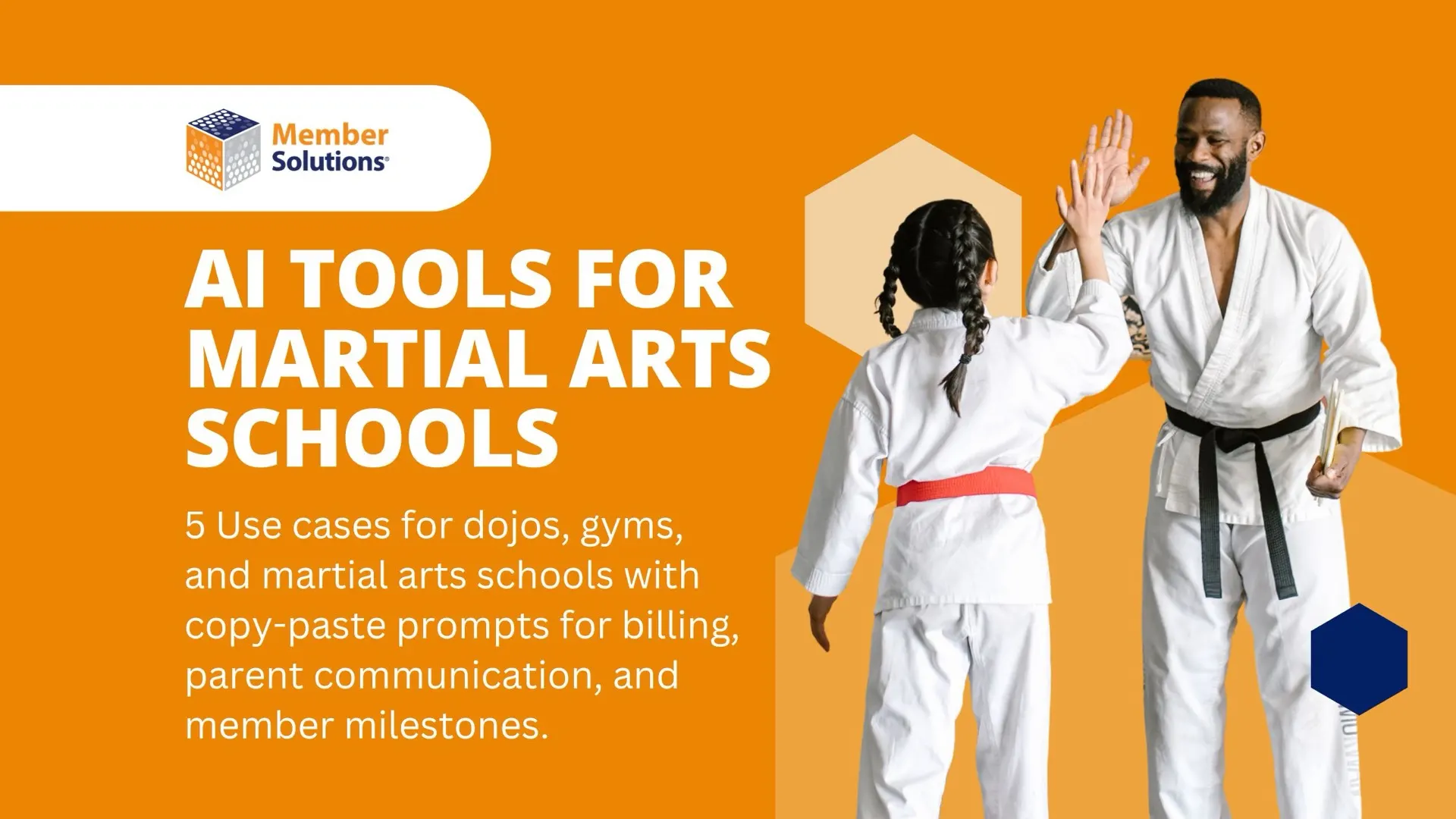
This guide covers what’s actually worth using right now, what’s still hype for a school your size, and copy-paste prompts for the parts that work, including karate dojos, BJJ gyms, taekwondo academies, and MMA studios.
Member Solutions works with 1,000+ martial arts schools and fitness studios. The use cases below come from what school owners are actually doing right now.
Jump to a section:
- What’s Worth Using Right Now (and What to Skip)
- What AI Can Do for a Martial Arts School
- Use Case 1: Parent Communication After Belt Tests
- Use Case 2: Billing Reminders and Failed Payment Follow-Ups
- Use Case 3: Social Media Content
- Use Case 4: Student Milestone Messages
- Use Case 5: Lapsed Student Reactivation
- Use Case 6: Newsletter Writing
- Use Case 7: Event and Tournament Promotion
- Use Case 8: New Student Onboarding Sequences
- Which AI Tool Should You Use
- AI and Your Membership Management Software
- What Real School Owners Are Doing
- What AI Cannot Do for Your School
- Your AI Resource Library
- Frequently Asked Questions
What’s Worth Using Right Now (and What to Skip)
Not every “AI-powered” pitch is built for a school your size. Some of it is genuinely useful. Some of it is a feature built for a 12-location chain, repackaged and sold to you anyway. Here’s the honest split.
Worth using now:
- Billing follow-up. Drafting the message for a failed payment or a past-due account. See Use Case 2 below.
- Parent and student communication. Belt-test notes, lapsed-student check-ins, milestone messages. See Use Cases 1, 4, and 5.
- Responding to new leads fast. A prospective family who fills out a form at 9pm shouldn’t wait until you’re back at the desk tomorrow. This is worth a closer look. If you’re deciding whether a full AI receptionist is worth it or whether a lighter setup covers the same ground, we broke that down separately.
Skip for now, unless something changes:
- Dynamic AI pricing. Software that adjusts your membership pricing based on demand and market trends. Built for multi-location operators with real pricing variance to optimize. A single school doesn’t have enough pricing levers to make this worth the cost.
- AI-controlled HVAC and facility systems. Real technology, real energy savings at scale. For one facility, the setup cost usually outlasts the savings.
- Voice-activated gym management. Members booking classes by talking to a speaker sounds convenient. In practice, it solves a problem most schools don’t have: your front desk or app booking already handles this.
- AI form-correction cameras and VR workouts. Interesting technology, aimed at large fitness chains with the budget to install and maintain it. Not where a martial arts school’s time or money is best spent right now.
The pattern: AI is worth using when it removes a task you’re already doing badly or too late (a message you’re behind on sending, a lead you didn’t get back to). It’s not worth it when it’s solving a problem you don’t have, just because a vendor built the feature.
For a broader breakdown of what to automate first if you’re just getting started, see AI automation for gyms: what to automate first.
What AI Can Do for a Martial Arts School
Think of AI as a first-draft tool. You tell it what you need, it writes a starting point, you edit it to sound like you, and you send it. That’s really the whole workflow.
The time savings add up quickly. Writing a personal email to 12 belt-test families from scratch can take a couple of hours. With AI, you’re reviewing and lightly editing drafts, which turns that into a 30-minute task. When you apply that same approach to parent communications, billing follow-ups, social posts, newsletters, and event announcements, most school owners find they get back 8 to 12 hours a week.
That’s consistent with what we’re seeing in how AI is changing gym marketing.
The process is the same for every use case in this guide:
- Give AI the context (who, what, tone, length)
- Review the draft
- Edit anything that doesn’t sound like you
- Send
A quick edit is always faster than a blank page.
Use Case 1: Parent Communication After Belt Tests
The situation: You promote 14 students on a Thursday and want to email their parents by Friday morning with a genuine, personal note. Writing 14 individual emails is a lot, and a mass message won’t have the same impact.
What AI does: It drafts each email in under 30 seconds. You read it, swap in a specific detail you remember about the student, and send.
Copy this prompt:
Write a short, personal email to a parent whose child just earned their [BELT COLOR] belt in [DISCIPLINE — e.g. BJJ / karate / taekwondo]. The student’s name is [NAME]. The school is [SCHOOL NAME]. Tone: warm, specific, and genuine — not corporate. Mention that earning this belt means the student has shown [SPECIFIC QUALITY — e.g. “persistence when the drills got hard” or “real improvement in their guard passing”]. End with an open invitation to reply with questions about what comes next. Under 150 words.
After you get the draft: Fill in the brackets, read it out loud, and adjust any line that doesn’t sound like something you’d say. Most owners spend about 3 to 4 minutes per email this way instead of 20.
Personal communication after milestones is one of the most reliable tools for martial arts student retention. Families who hear from you directly after a big moment are much more likely to stay enrolled, refer friends, and come back after a break. For more on what keeps students coming back long-term, our martial arts client retention strategies guide is a helpful read.
Use Case 2: Billing Reminders and Failed Payment Follow-Ups
The situation: A parent’s tuition payment didn’t go through, and you need to reach out. You want to handle it in a way that’s clear and helpful without making it feel awkward or stiff.
What AI does: It drafts a message that’s warm and easy to act on. You add the family’s name and your payment update link.
Copy this prompt:
Write a short text message from a martial arts school owner to a parent whose monthly tuition payment failed. Tone: helpful and low-pressure — make it easy to take action (update a card, call the school, or reply to the text). Assume the parent is busy and missed it. Under 80 words. Leave a blank line where I’ll add the payment update link.
The result: A message that sounds like it came from a person, because you shaped it before it went out.
Billing conversations can feel uncomfortable on both sides, and why billing issues feel personal is worth reading to understand the dynamic. For templates that are already written and ready to customize, our billing conversation templates guide and professional payment reminder emails are great starting points.
AI gets you to a draft faster. The edit you make — the line that sounds like you and the acknowledgment that makes the message feel human are what make it land well.
Use Case 3: Social Media Content
The situation: You know consistent social media posting helps, but after teaching classes all day and catching up on emails, sitting down to write captions just doesn’t happen.
What AI does: It gives you a full week of posts in one short session. A 20-minute block with AI can produce more usable content than most school owners create in an entire month.
Copy this prompt:
Write 5 social media posts for a [DISCIPLINE] school. Each post: under 100 words, friendly and not salesy, works on Instagram or Facebook. Topics: 1) a student milestone (keep it anonymous), 2) a behind-the-scenes moment from class, 3) a practical tip for new students, 4) an upcoming belt test or event announcement, 5) a community shoutout. School name: [SCHOOL NAME]. Students range from [AGE RANGE].
Writing five posts from scratch takes most people 60 to 90 minutes. Reviewing and tweaking AI drafts takes around 20. For more on building a consistent content routine, see what a AI social media content strategy for gyms looks like in practice, and how content strategy for martial arts businesses fits into the bigger picture.
Use Case 4: Student Milestone Messages
The situation: A student hits their 1-year training anniversary, their 100th class, their first competition, or their black belt. You want to acknowledge it, but the right words don’t always come easily in the moment.
What AI does: It drafts a message in under a minute. You make it specific to that student.
Copy this prompt:
Write a short congratulations message for a student who just reached their 1-year training anniversary at our school. Name: [NAME]. Discipline: [DISCIPLINE]. Age: [AGE / “adult”]. The message should be genuine, specific, and acknowledge that showing up consistently over a full year takes real dedication. Under 100 words. Will be sent as a personal text from the owner.
The pattern is the same every time: give AI the context, review the draft, make it specific to this person, and send. The structure is usually the hardest part, and AI handles that for you.
Milestone recognition is one of the 16 student retention tools that high-retention schools use on a regular basis. It’s a simple, low-cost touchpoint that goes a long way toward making students and families feel seen.
Use Case 5: Lapsed Student Reactivation
The situation: A student you haven’t seen in a few weeks. You want to check in, but you don’t want to come across as pushy or make it feel like a sales call.
What AI does: It drafts a warm, no-pressure check-in message that opens the door without forcing anything.
Copy this prompt:
Write a short, personal email from a martial arts school owner to a parent whose child hasn’t come to class in three weeks. Tone: warm and zero-pressure — let them know we noticed and the door is open. Don’t mention billing. Under 120 words. Student: [NAME]. School: [SCHOOL NAME].
Reaching out within the first 21 days makes a real difference. Students who receive a personal check-in in that window are much more likely to return than those who don’t hear anything. After 30 days, the window starts to close. For more on understanding why students quietly drift before they cancel, why involuntary attrition is killing your member retention and 5 messages that keep members engaged when they stop showing up are both really useful.
The summer communication templates guide also has ready-to-send messages for reaching adult students during the slower months of the year.
Download the full library: The AI Prompt Library for Martial Arts Schools has 30+ copy-paste prompts covering billing, communication, social media, event promotion, and more.
Use Case 6: Newsletter Writing
The situation: You know a regular newsletter would help keep families connected and engaged. You’ve tried to start one a couple of times, but the writing always takes longer than expected and it falls off the priority list.
What AI does: It drafts the newsletter from a short outline you give it. You review, add your school’s specific news, and send.
Copy this prompt:
Write a short monthly newsletter for a [DISCIPLINE] school. Include: 1) a brief personal note from the owner, 2) a student spotlight (keep anonymous, describe what they achieved), 3) an upcoming event or schedule change, 4) one practical tip for parents or students. Tone: warm, community-focused, not corporate. Under 400 words total. School: [SCHOOL NAME].
A regular newsletter keeps your school present in families’ minds between visits, and that connection is a big part of what keeps them enrolled. For a complete guide on newsletter formats that work specifically for martial arts schools, our martial arts school newsletter guide is the place to start.
The general framework for making email newsletters work for a fitness business covers platform setup, send frequency, and deliverability. And for gym newsletter ideas that apply across different disciplines, that guide has 20+ prompts you can adapt to fit your school.
Use Case 7: Event and Tournament Promotion
The situation: A tournament is six weeks out. You need a parent email, a social post, a follow-up reminder, and maybe a text. Between everything else on your plate, getting all of that written feels like a project in itself.
What AI does: It drafts all four in one session.
Copy this prompt:
Write an email announcement for an upcoming martial arts tournament at [SCHOOL NAME]. Event details: [DATE / TIME / LOCATION / WHO SHOULD ATTEND]. Tone: enthusiastic but clear — answer the three questions every parent has: what is it, does my child need to sign up, and what does it cost? Under 200 words. Include a subject line.
For a full breakdown of martial arts summer events and marketing strategies, including which types of events tend to drive the most enrollment and retention, that guide covers the planning side. AI covers the writing side. Together they make events a lot less stressful to promote.
See also: how to run gym events that actually keep members and fall events that boost enrollment and retention at martial arts schools.
Use Case 8: New Student Onboarding Sequences
The situation: A new family joins your school. You want to send them a welcome email, a what-to-expect note before their first class, and a check-in afterward. You’ve been meaning to set this up for a while but haven’t gotten around to it.
What AI does: It drafts all three emails in one session.
Copy this prompt:
Write a 3-email onboarding sequence for a new student joining a [DISCIPLINE] school. Email 1: warm welcome (sent day of enrollment, under 150 words). Email 2: what to expect before their first class — parking, what to wear, arrival time, who to ask for (sent 24 hours before first class, under 120 words). Email 3: check-in after first class — ask how it went, answer any questions, note what’s next (sent day after first class, under 100 words).
A solid onboarding sequence makes a big difference in early retention. The first 30 days are when new students decide whether they’re going to stick with it, and a few well-timed, friendly emails help them feel like they made the right choice. For more on how to get more martial arts students and what happens after the first inquiry, that guide covers the full enrollment funnel.
Which AI Tool Should You Use
ChatGPT, Claude, and Google Gemini all work well for everything in this guide, and all three have free versions. You don’t need to spend anything to get started.
The specific tool matters less than finding one you’ll actually use. Try one for a week and see how it fits your workflow. Most school owners find the first couple of weeks feel a little slow while they get comfortable with how to phrase things. By week three it starts to feel natural and fast.
For AI prompts already formatted for gym use cases, that guide has platform-specific recommendations. If you’re interested in AI for gym marketing beyond just communications, that guide covers ad copy, SEO content, and lead follow-up sequences. And if you’re deciding what to automate first, AI automation for gyms: what to automate first walks through the order that makes sense.
AI and Your Membership Management Software
AI is great for the communication side of running your school. Your membership management software handles the rest: billing, hold management, enrollment tracking, payment reminders, and the data that tells you which students might be drifting before they cancel.
The two work well together. AI drafts the lapsed-student message. Your software tells you which students need it. AI writes the payment reminder. Your software sends it on schedule.
For schools exploring the best membership management software and how it fits with an AI communication approach, that guide compares options across the features that matter most for martial arts schools. Member Solutions is built specifically for martial arts schools, gyms, and fitness studios. You can learn more about our martial arts platform or book a demo to see it in action.
What Real School Owners Are Doing
Peter Malik of World Martial Arts in Palo Alto grew his school from 30 to 185 students without ever running a paid ad. His growth comes entirely from parent-to-parent referrals, and those referrals happen because families feel genuinely connected to his school. A big part of that connection is personal communication: a real note after a belt test, a thoughtful check-in when a student went quiet, a message that made a parent feel like someone was actually paying attention. AI makes that kind of consistent, personal communication a lot easier to sustain at scale. You can read Peter’s full story here.
The schools we work with that have the strongest retention are the ones that communicate consistently and make it feel personal. AI is the tool that makes that sustainable without burning anyone out. For more on the best member retention strategies and a complete member retention guide for fitness businesses, those resources cover the full picture.
What AI Cannot Do for Your School
Before wrapping up, it’s worth being honest about where AI has real limits.
AI can draft. You still make the call.
It doesn’t know that a parent is going through a stressful time at home. It doesn’t know that the student who stopped coming has a situation that needs a gentle approach. It doesn’t know the specific thing you said on the mat last Tuesday that made something click for a student.
Those details are yours, and they’re what makes the edit worth doing. AI gives you a strong starting point. The specific detail you add, the line you change to sound more like yourself, the acknowledgment that shows you were paying attention. That’s what turns a draft into something that actually lands.
The AI for gym owners guide goes deeper on where AI adds the most value and where your judgment stays in the driver’s seat.
Your AI Resource Library
- Should You Get an AI Receptionist for Your Martial Arts School? — a closer look at the one “worth using” category that has the most hype attached to it
- AI Automation for Gyms: What to Automate First — if you’re starting from zero, this is the order to do it in
- AI Prompt Library for Martial Arts Schools — 30+ copy-paste prompts, organized by use case
- Billing Conversation Templates — for failed payments, late fees, and policy conversations
- Summer Communication Templates — check-ins, re-engagement, and slow-season outreach
- Martial Arts School Newsletters: The Complete Guide — full copy-paste newsletter templates
- Member Retention Guide — the complete picture on retention strategy
Frequently Asked Questions
Q: Do I need any technical background to use AI tools? A: Not at all. Copy the prompts from this guide, fill in the brackets, and submit. If the result doesn’t feel right, try adding something like “make it shorter” or “make it sound less formal” and go again. That’s genuinely all it takes.
Q: What if the AI writes something that doesn’t sound like me? A: That’s totally normal and easy to fix. Read the draft out loud, change the lines that feel off, and delete any phrases you’d never actually say. Keep the structure and fill in your own words. A quick edit is always faster than starting from scratch, even when the draft needs some work.
Q: Is it safe to put student names in AI prompts? A: Use first names only. Skip last names, addresses, medical information, and anything beyond what’s needed for the draft. For billing-related prompts, don’t include account numbers or payment details. First name and context is all you need.
Q: Can I use AI to write my entire newsletter every month? A: Yes, as a starting point. The newsletters that connect best with families are the ones that feel personal and specific to your school, so you’ll always want to add your real news and your own voice before sending. AI handles the blank-page problem. The rest is a quick edit. See the full martial arts school newsletter guide for templates that make it easy.
Q: How do I know if AI is actually saving me time? A: Try tracking it for a week. Note how long you spend on parent communication, billing follow-ups, social posts, and event announcements. Then try the same week with AI and compare. Most school owners find they get back several hours, which goes right back into teaching, being on the floor, and the parts of running a school that actually need you there.
Q: How do I tell a real AI tool from a hyped-up one? A: Ask what specific task it replaces, and how long that task takes you now without it. If the answer is vague (“it optimizes your operations”) or the task is one you don’t actually do often, it’s probably not worth the setup time. If it replaces something you’re already doing badly or too late, like a billing follow-up you keep putting off, it’s worth a real look.
Q: Is an AI receptionist worth it for a school my size? A: Sometimes, depending on how many leads you’re missing after hours. We broke down how to make that call without the sales pitch.