If email newsletters have been sitting on your to-do list for a while, you’re not alone. Most martial arts school owners know they should be sending them regularly, and life just keeps getting in the way. Between teaching classes, managing billing, and everything else on your plate, writing a newsletter can feel like one more thing you don’t have time for.
Here’s the good news: it doesn’t have to be complicated. And the payoff is real.
Families who hear from you consistently stay enrolled longer, refer more students, and come back after breaks. Think of it this way — social media helps new people discover you, while newsletters keep the families you already have feeling connected and valued. The research on member retention across fitness businesses backs this up time and time again: connected members stick around.
This guide gives you every newsletter type your school should be sending, with full copy-paste templates, subject lines, and timing for each. We’ll also cover platforms, frequency, and how to use AI to make the writing faster.
Member Solutions works with 1,000+ martial arts schools, BJJ gyms, taekwondo academies, karate dojos, and fitness studios. These templates come from what we’ve seen work across hundreds of schools.
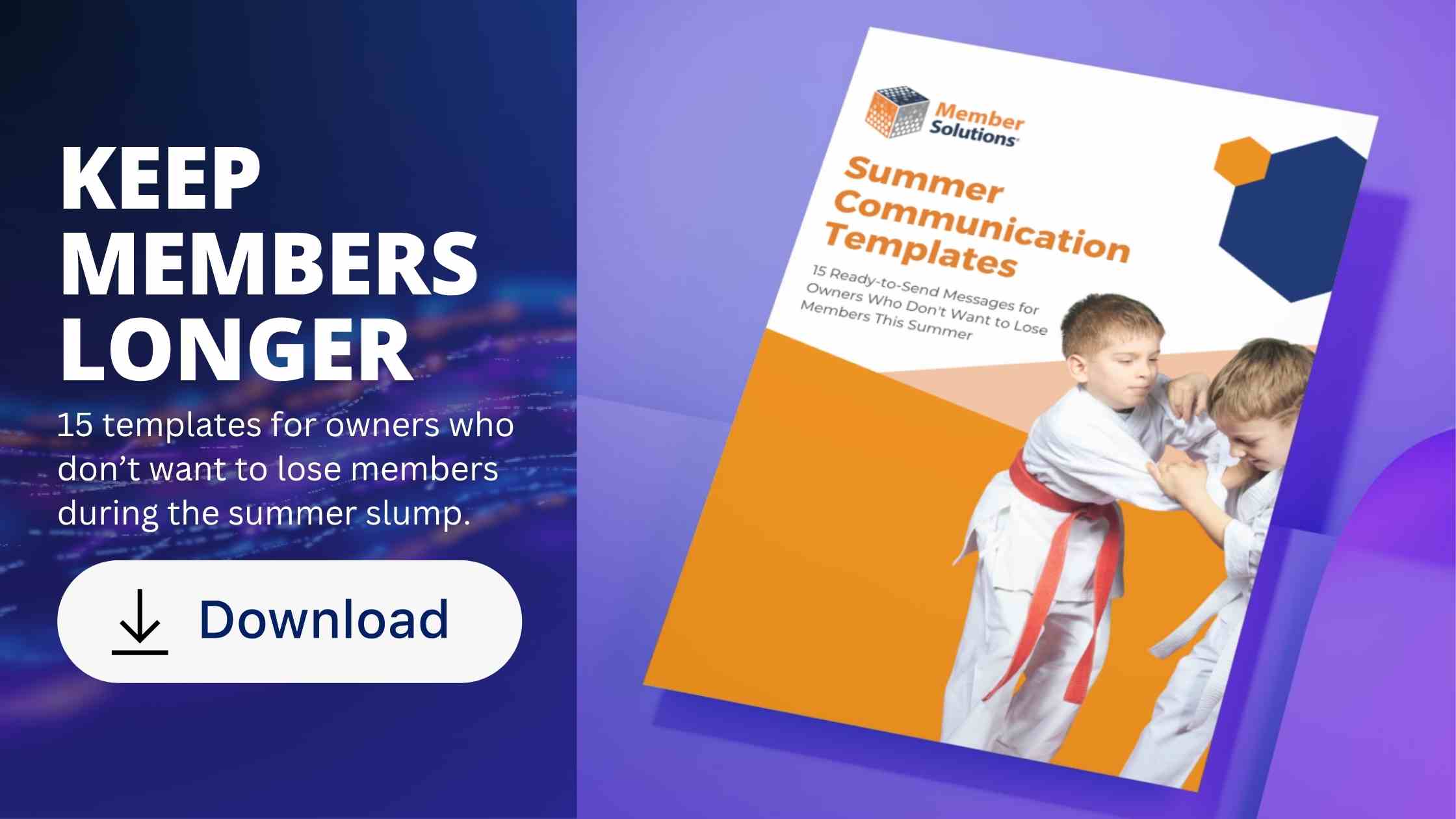
For copy-paste seasonal templates ready to send this summer, grab the download below.
Jump to a section:
- Why Newsletters Are Your Best Retention Tool
- Who You’re Writing To
- Newsletter Type 1: Belt Milestone Emails
- Newsletter Type 2: Event and Tournament Announcements
- Newsletter Type 3: Lapsed Student Win-Back
- Newsletter Type 4: Seasonal Newsletters
- Newsletter Type 5: Billing Reminders
- Subject Line Formulas That Actually Get Opened
- How Often Should You Send
- Email Platforms for Martial Arts Schools
- Using AI to Write Newsletters Faster
- What the Best Schools Are Doing
- Newsletter Mistakes to Avoid
- Frequently Asked Questions
Why Newsletters Are Your Best Retention Tool
The average gym or studio loses 30 to 50% of its members every year. Understanding what a good member retention rate looks like for martial arts schools comes down to one thing more than almost any other: how connected families feel between visits.
A parent who gets a warm, personal email after their child’s belt test feels seen. They feel like they chose the right school. And that feeling keeps them enrolled. On the flip side, families who don’t hear from their school for weeks at a time can start to quietly drift. It’s rarely dramatic. They just slowly stop showing up. For a closer look at why that happens, why involuntary attrition is killing member retention is a helpful read.
The member retention guide for fitness businesses identifies communication as the highest-leverage retention activity available to small and mid-size schools, ranking higher than pricing changes, program additions, or facility upgrades. You can have the best instruction in town and still lose families to a school that communicates better and more often.
Email works because it’s direct and personal. Unlike a social media post that disappears in a feed, an email stays in someone’s inbox until they open it. Families who signed up for your list are telling you they want to hear from you. This guide helps you give them something worth reading.
Who You’re Writing To
In martial arts, the person training and the person paying are often different, and that distinction matters a lot for how you write.
For youth students: You’re writing to parents. They made the decision to enroll, they manage the schedule, and they’re the ones who decide whether training continues. Write to them as partners in their child’s development, not as customers managing a subscription. Reference what their child is specifically working on. Acknowledge the time and commitment they’re investing, not just the financial side.
For adult students: Write directly to the student. They appreciate peer-level communication that’s honest and specific. An adult who just earned their blue belt in BJJ wants to understand what that progression means technically, not just receive a generic congratulations.
If you have both: Segment your list. A belt milestone email to a parent and one to an adult student look completely different. Most email platforms make segmentation easy, and if you’re on Member Solutions, our built-in tools let you do this right from your member database.
This is part of what strengthening martial arts student retention through communication covers in depth. The simpler version: the more specific your message, the more it lands.
Newsletter Type 1: Belt Milestone Emails
When to send: Within 48 hours of any belt promotion test
Who it goes to: Parents of promoted students, or directly to adult students
Why it matters: Belt tests are the most emotionally meaningful moment in a student’s martial arts journey. A personal note from the school owner, not from “the team” or an automated system, turns that moment into a memory. Families who receive this kind of message stay enrolled longer and refer more students.
Subject line options:
[Student Name] earned their [Belt Color] belt — here's what that meansBig news about [Name]'s progress at [School Name][Name] passed their belt test — we wanted you to hear it from us
The email:
Hi [Parent Name],
I wanted to reach out personally because [Student Name] did something worth celebrating.
They passed their [Belt Color] belt test this week.
That might sound like a routine milestone, but earning a [Belt Color] belt at [School Name] means they’ve worked through [SPECIFIC SKILL], they’ve showed up consistently even when it was hard, and they’ve shown the kind of discipline that doesn’t come from talent. It comes from showing up.
You should be proud. We are.
The next step for [Name] is [Next Belt or Stage]. If you’d like to know what that involves or when the next grading is, just reply to this email.
Thank you for trusting us with [Name]‘s training.
[Your Name]
[School Name]
What makes this work: Two lines carry most of the weight — “I wanted to reach out personally” and “Thank you for trusting us with [Name]‘s training.” The first signals this isn’t automated. The second positions you as a partner in their child’s growth, not just a service provider. Both are true, and both sound like a person because they should.
Newsletter Type 2: Event and Tournament Announcements
When to send: 4 to 6 weeks before any tournament, grading event, demo day, or seasonal program
Who it goes to: Your full active list, or segmented by age group or belt level
Why lead time matters: Parents need time to plan. Schools that send clear, early announcements consistently see better attendance than those relying on verbal reminders and posted flyers. For a full look at fall events and activities that boost martial arts enrollment and retention and summer event marketing strategies, those guides cover the planning side. This template covers the communication side.
Subject line options:
[Event Name] is coming up — here's what you need to knowRegistration is open for [Event Name] — spots are limited[Name]'s next big moment: [Event Name] on [Date]
The email:
Hi [First Name],
I want to give you plenty of notice about something coming up at [School Name].
[EVENT NAME]
Date: [Date]
Time: [Time]
Location: [Location][2 to 3 sentences describing the event in plain language. Is it competitive or participatory? What should students expect?]
Who should come: [Age group / belt level / all students]
Cost: [Amount or “Included in your membership”]
How to register: [Link or “Reply to this email”]
Registration deadline: [Date]If you’re not sure whether this is the right fit for [Name] at their current level, ask a coach before or after class. We’re happy to help you decide.
[Your Name]
[School Name]
Follow-up sends: One reminder a week before the registration deadline, and a short “last chance” the day before it closes. Both can be brief — the original email does the heavy lifting, and the follow-ups just catch people who missed it.
Newsletter Type 3: Lapsed Student Win-Back
When to send: When a student hasn’t attended in 3 to 4 weeks and hasn’t cancelled
Who it goes to: Parent (for youth students) or the student directly (for adults)
Why timing matters: Reaching out early makes a real difference. Families who receive a personal check-in within the first 21 days of going quiet are much more likely to come back. The longer you wait, the harder it becomes. After 60 days, you’ve moved from retention into re-acquisition territory, which takes a lot more effort.
For more on catching members before they disappear and understanding the patterns that signal someone is about to cancel, why involuntary attrition is killing member retention is worth reading.
Subject line options:
We noticed [Name] hasn't been in — just checking inA quick note from [School Name] about [Name]Still here when you're ready, [Name]
The email (for parents of youth students):
Hi [Parent Name],
I noticed [Student Name] hasn’t been in for a few weeks. I wanted to reach out personally — not to chase you, just to make sure everything’s okay.
If [Name]‘s schedule has changed, or if something happened that made coming back feel harder, I’d genuinely like to know. Sometimes we can work around a schedule conflict, help with the transition back, or just talk.
If [Name] has moved on from martial arts for now, no hard feelings at all — we were glad to be part of their journey.
Either way, just reply to this email or call us at [Phone Number].
[Your Name]
[School Name]
The email (for adult students):
Hi [First Name],
It’s been a few weeks since you’ve been in and I wanted to check in.
If life got busy (it does), your spot is still here. No awkwardness. Just come back when you’re ready.
If something specific made it hard to return — an injury, a schedule change, something that happened in class — I’d genuinely like to know. That’s how we get better.
Feel free to reply here or just walk in. We’d be glad to see you.
[Your Name]
[School Name]
One important note: Keep billing out of this email entirely. That’s a separate conversation. This message is about the person, not the account. See our billing conversation templates and freeze and cancellation scripts for how to handle the financial side when the time comes.
Newsletter Type 4: Seasonal Newsletters
Martial arts schools follow pretty predictable seasonal rhythms. Enrollment tends to pick up in September and January, and attendance naturally dips in summer and around the holidays. The good news is that once you know what to expect, it’s easy to get ahead of it rather than scrambling when it arrives.
Summer: Send a “we’re here all summer” email in late May or early June. Promote summer camps, summer schedules, and any seasonal specials. The martial arts summer camps guide covers the program side, and our summer communication templates have ready-to-send copy you can use right now.
Back to school: Send in mid-August, before the school year starts. Remind families about your fall schedule, share what students who trained over the summer have been working on, and make it easy for anyone who took a break to come back. The back-to-school marketing guide for martial arts schools and how to grow your school during back-to-school season both dig into this period.
January: This is often your biggest enrollment month. A “fresh start” email in the first week of January works well. Skip the discount and lean into what training actually gives someone who wants to start the year with intention.
The pattern for every seasonal email: Acknowledge the season, connect it to something your members genuinely care about, and make it simple to engage. No pressure, no countdown timers.
Newsletter Type 5: Billing Reminders
Billing communication is worth keeping in its own category. When a billing reminder shows up in the same thread as your community newsletter, families start associating your emails with “this might be about money,” and open rates for everything else tend to drop.
Keep financial messages separate and clearly labeled so members know what they’re opening before they open it.
For failed payments: A helpful, friendly message that makes it easy to update payment information. Our professional payment reminder email templates have copy that’s already written and tested.
For late fees: Plain, warm language that explains what happened and how to resolve it, without making anyone feel like they did something wrong. Why billing issues feel personal is a helpful read before writing these, because the emotional context really does matter.
For renewal reminders: A personal note works better than an automated form. Members who renew after hearing from you personally feel better about it than those who receive a system-generated notice.
The full framework for billing conversations that build trust covers the trickier situations, including when a member pushes back, asks to freeze, or says they want to cancel.
Subject Line Formulas That Actually Get Opened
The subject lines that perform best are personal and specific. Generic lines like “Newsletter — June” or “Update from [School Name]” tend to get skipped, even by families who genuinely like your school.
What works well:
- Put the student’s name in the subject when relevant:
[Name] earned their blue belt — here's what that means - Name the event specifically:
Beginner tournament: June 14 — does [Name] want to compete? - Be direct for win-backs:
We noticed [Name] hasn't been in — just checking in - Use plain, conversational language:
A quick note about summer schedulesbeatsImportant Summer Schedule Update
What tends to hurt:
- ALL CAPS subject lines
- Excessive punctuation (!!!, ???)
- “FREE” or “DISCOUNT” in the subject line (these can trigger spam filters)
- Vague teasers that don’t tell people what’s inside
The gym newsletter ideas guide has 20+ subject line templates across different email types, and how to make email newsletters work for your fitness business covers deliverability and open rate basics.
How Often Should You Send
The sweet spot isn’t about a fixed calendar — it’s about sending when something real has happened.
An email that goes out because a belt test just happened, or because a tournament is coming up, or because you noticed a student hasn’t been in for a few weeks, will always perform better than a “monthly newsletter” sent because it’s the end of the month.
A good target is 3 to 5 emails per month, each tied to a real moment in your school’s calendar. If one month is lighter, that’s okay. The goal is to stay meaningfully present, not to hit an arbitrary number.
Email Platforms for Martial Arts Schools
The best platform is the one you’ll actually use. For schools under 500 subscribers, the most common options are:
- Mailchimp — widely used, free up to 500 subscribers, solid templates
- Constant Contact — slightly more expensive, with better customer support
- ConvertKit — great for segmented lists if you have both youth and adult programs
- Member Solutions — built-in communication tools that let you send segmented emails directly from your member database, without managing a separate list
Start with whatever requires the fewest new logins and passwords. You can always migrate to something else later. The platform matters far less than actually pressing send.
For schools looking at the best membership management software that includes built-in communication tools alongside billing and enrollment, that guide compares options across the features that matter most for martial arts schools.
Using AI to Write Newsletters Faster
The biggest barrier to consistent newsletters is usually the writing itself. AI can help a lot with that.
Tools like ChatGPT, Claude, and Google Gemini can draft a starting point for any of these newsletter types in under a minute. You give it a quick outline of what you want to say — the belt test that happened, the upcoming event, the student who reached a milestone — and it gives you a draft to work from. You review it, add the specific details that make it yours, and send.
Most school owners who start using AI for newsletter writing find they save 2 to 3 hours per newsletter. Over a year, that adds up to a lot of time back.
For the full guide on how martial arts schools are using AI across billing, social media, student communication, and more, see AI for martial arts schools: how to save 10 hours a week. The AI Prompt Library for Martial Arts Schools has 30+ prompts ready to use today.
What the Best Schools Are Doing
Peter Malik of World Martial Arts in Palo Alto grew from 30 to 185 students over 17 years without running a single ad. Every new student came from a parent telling another parent. And those conversations were sparked by moments of connection — a personal belt test email, a thoughtful check-in when a student went quiet, a note that made a parent feel like someone was genuinely paying attention. Read Peter’s full story here.
Shane Nizzardo of Underground Fitness in Connecticut has been open for 19 years, outlasting every competing gym in his area. One of his guiding beliefs: “If your core members are happy, they’re going to be your walking billboards.” Consistent, personal communication is a big part of how he keeps that connection alive. Shane’s story is here.
Both schools have built something that lasts, and personal communication is right at the center of how they did it. For a broader look at martial arts marketing strategies that incorporate email into a full growth approach, that guide covers the whole picture.
Newsletter Mistakes to Avoid
Sending from a generic address. “info@yourschool.com” doesn’t build a relationship. Send from your name, or at minimum “[Your Name] at [School Name].” People open emails from people they know.
Writing generic fitness content. Tips like “5 ways to stay motivated” don’t connect with a parent whose child just tested for their yellow belt. Martial arts school owners are educators, not gym managers. Let your newsletters sound like that.
Mixing billing into community emails. Keep financial messages in their own thread. When billing reminders show up alongside community news, families start treating all your emails as potentially billing-related, which hurts open rates across the board.
Sending so infrequently that it feels random. Once a quarter doesn’t give families enough touchpoints to feel genuinely connected to your school. Try for at least once a month, tied to something real.
Including too many calls to action in one email. Pick one thing you want families to do — register for the tournament, update their payment info, or reply to check in. Too many asks usually leads to no action at all.
Frequently Asked Questions
Q: How do I build my email list if I’m starting from scratch? A: Start with every family currently enrolled. Add new members at sign-up as a natural part of your onboarding. If a parent asks why you need their email, the honest answer is: “We send updates about your child’s progress, upcoming events, and schedule changes. It’s the easiest way to stay in the loop.” Most parents are happy to hear that.
Q: What’s the right subject line length? A: Aim for 40 to 50 characters. That’s long enough to say something meaningful and short enough to display fully on a phone screen. Most emails are opened on mobile these days, so if your subject line gets cut off in the preview, you’ve likely already lost the open.
Q: Should I send different emails to parents of beginners vs. advanced students? A: Yes, when the content is genuinely different. Belt milestone emails are always specific to the student. Event announcements can be segmented by age group or belt level when the event is targeted. General school news can go to everyone. The martial arts client retention guide covers segmentation as part of a broader retention strategy.
Q: What if a parent unsubscribes? A: Honor it right away (your email platform handles this automatically). Most unsubscribes happen when someone is getting too much email, not because they dislike your school. Before making big changes, look at your send frequency and content to see if there’s a pattern. One or two unsubscribes a month at a school of 100+ students is completely normal.
Q: How do I handle a parent who prefers text over email? A: Text them! The goal is staying connected, not being loyal to one channel. Some parents open every email. Others respond much faster to a quick text. Get to know your families well enough to know which is which, and go with what works.